

Geneva to Milan by Train: Direct Services, Tickets & Travel Tips

The train from Geneva to Milan is one of the most convenient ways to travel between Switzerland and northern Italy. A direct EuroCity takes as little as 4 hours 23 minutes, following Lake Geneva and the Rhône Valley before crossing the Alps through the Simplon Tunnel.
There's no airport transfer or flight connection to worry about. You can leave central Geneva and arrive at Milano Centrale, with onward trains and metro connections available in the same station complex.
But there's one detail worth checking before you book: not every date offers the same number of direct trains. Construction work along the Italian section of the route has reduced some weekday services, and discounted international tickets come with different change and refund rules.
Here's what to know before choosing your train.
Geneva to Milan Train: Quick Overview
Direct EuroCity trains connect Genève-Cornavin, Geneva's main railway station, with Milano Centrale.
The route travels through western Switzerland, passing Lausanne and the Lake Geneva region before continuing toward Brig, Domodossola and Milan.
| Journey detail | What to expect |
|---|---|
| Departure station | Genève (Cornavin) |
| Arrival station | Milano Centrale |
| Fastest advertised direct journey | Around 4h 23m |
| Train operator | SBB / Trenitalia EuroCity |
| Direct connections | Normally up to 4 daily; fewer on some dates |
| Published promotional fare | From CHF 41, second class |
| Seat reservation | Included in standard international EC tickets |
| Main route | Lausanne – Brig – Domodossola |
| Border crossing | Through the Simplon corridor |
Prices and journey times are published references rather than live quotes. Train availability and schedules depend on your travel date.
For most travelers, a direct EuroCity is the simplest option. You remain on the same train from Geneva to Milan without changing at the Swiss–Italian border.
Is There a Direct Train from Geneva to Milan?
Yes. SBB operates direct EuroCity connections between Geneva and Milan, with a normal published service pattern of up to four departures per day.
These are international long-distance trains operated in cooperation with Trenitalia.
The journey is straightforward: board at Genève-Cornavin, settle into your reserved seat and remain on the train until Milano Centrale.
However, you may notice that some dates show fewer direct departures than others.
Why Are Some Direct Trains Missing?
This is worth knowing, particularly if you're planning a trip well in advance.
Construction work on the railway between Domodossola and Milan has affected EuroCity services along the Simplon corridor.
According to SBB, during 2026 one fewer train per direction is scheduled on certain weekday services connecting Geneva, Brig and Milan.
The infrastructure project is expected to continue until at least the end of 2028, although that doesn't mean every train will be disrupted throughout that period.
This is why you shouldn't rely on the same four daily departures being available for every date.
Before booking, check the actual EuroCity services operating on your travel day.
What If There's No Convenient Direct Train?
A journey with one connection may still be available.
Depending on the timetable, you might travel from Geneva toward Lausanne or Brig and change to another train continuing to Milan.
For example:
Genève → Lausanne or Brig → Milano Centrale
The exact interchange depends on the services available that day.
Be careful when comparing these results. A journey with a connection may take longer, and a combination of separate tickets can have different conditions if your first train is delayed.
If a convenient direct EuroCity is available, I'd generally choose it over a slightly cheaper connection that adds unnecessary waiting or complexity.
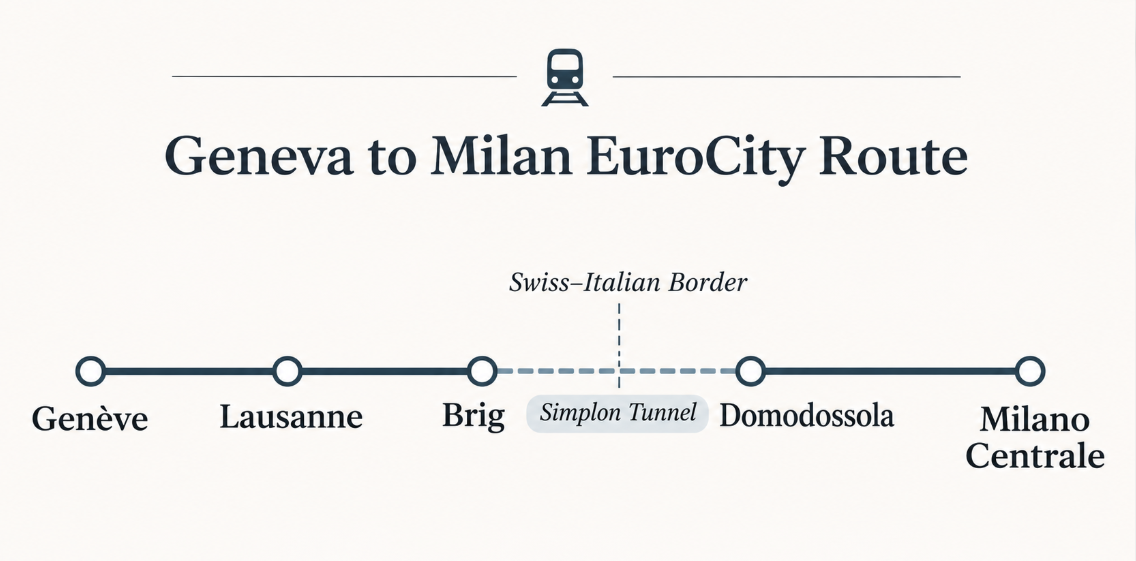
The EuroCity Route: What Will You See?
One reason to take the train from Geneva to Milan is the scenery.
The journey follows the Simplon corridor, a different Alpine railway route from the Gotthard line used by many Zurich–Milan services.
Geneva to Lausanne and Lake Geneva
After leaving Genève-Cornavin, the train heads east toward Lausanne.
Beyond Lausanne, the railway follows the northern shore of Lake Geneva, passing the Lavaux wine-growing region and the Montreux area.
This is one of the most attractive parts of the journey, with views across the water toward mountains on the opposite shore.
If scenery matters to you, a daytime train is a good choice.
Through the Rhône Valley and Simplon Tunnel
From the Lake Geneva region, the route continues into the Rhône Valley toward Brig.
The mountains become more prominent as you travel deeper into the Alps.
After Brig, the railway passes through the Simplon Tunnel into Italy, emerging near Domodossola.
You won't see mountain panoramas while the train is inside the tunnel, but the landscapes on either side make the journey interesting.
From Domodossola to Milan
The Italian section heads south toward the Lake Maggiore area and then continues to Milan.
Depending on the service, you may pass stations such as Stresa before reaching the metropolitan area.
As you approach Milan, the landscape gradually changes from mountain scenery to suburban and urban development.
The train finishes at Milano Centrale, one of Italy's largest railway stations.
A useful distinction: This is the regular EuroCity route, not the Bernina Express. The Bernina scenic railway follows a different route through Switzerland and isn't the direct way to travel from Geneva to Milan.
How Much Does the Geneva to Milan Train Cost?
SBB advertises promotional second-class tickets from CHF 41, including the required seat reservation.
That's a starting price for limited availability, not a fixed fare for every departure.
The amount you pay depends on your travel date, the train, class, booking time and available fare.
First-class tickets are also available, but the difference in price will depend on the particular service and offer.
Standard vs SMART vs SMART2 Tickets
International EuroCity fares have different conditions, and the cheapest ticket isn't always the best choice if your schedule might change.
Trenitalia's international SMART offers are one example.
| Ticket type | Main condition | Flexibility |
|---|---|---|
| Standard / Adult | Regular international fare | Check applicable fare rules |
| SMART | Limited discounted offer | No changes or refunds |
| SMART2 | Discounted offer with limited flexibility | Changes permitted under specific conditions; no refunds |
Under Trenitalia's published rules, SMART can be purchased up to seven days before departure, subject to availability.
SMART2 can be purchased up to three days before departure. A change before the booked train departs is possible by paying the difference compared with the full Standard fare.
Both discounted products are non-refundable.
Not every booking platform labels its offers in exactly the same way, so read the actual conditions displayed at checkout rather than assuming that a similarly named ticket has identical rules.
Should You Book in Advance?
For this international route, booking early is usually worthwhile if your dates are fixed.
Discounted EuroCity fares have limited availability, and cheaper offers may disappear as the train fills up.
SBB generally opens bookings for Italian international services up to around 180 days ahead, although some trains become available later.
This can happen around the annual timetable change in December or when construction arrangements haven't been finalized.
If a train doesn't appear several months ahead, that doesn't necessarily mean it has sold out.
Check again when the timetable and booking inventory are released.
Do You Need a Seat Reservation?
Yes. International EuroCity tickets between Switzerland and Italy include a seat reservation.
This differs from many ordinary Swiss domestic trains, where seat reservations are generally optional.
When you purchase a regular international EuroCity ticket, the required reservation is normally included in the ticket price.
You don't need to purchase the same seat reservation twice.
However, if you're using an Interrail or Eurail pass, check whether a separate EuroCity reservation is required for your international journey.
A rail pass doesn't necessarily eliminate the reservation requirement.
Can You Use a Swiss Travel Pass?
A Swiss Travel Pass covers eligible public transport journeys within Switzerland, but it doesn't automatically cover the entire EuroCity trip to Milan.
You'll need to make sure your booking covers the Italian portion of the route, together with the applicable international reservation.
The arrangement can depend on the specific pass and ticket product.
Don't assume that a Swiss domestic pass lets you board the international EuroCity all the way to Milano Centrale without additional ticketing.
How to Book Geneva to Milan Train Tickets
Search for Genève → Milano Centrale and enter your intended travel date.
When comparing available departures, pay attention to four details:
- Direct or connecting: Check whether the journey requires a change.
- Arrival station: Confirm that your train arrives at Milano Centrale.
- Fare conditions: Review refunds, date changes and train-specific restrictions.
- Seat reservation: Check what's included in your ticket or rail pass arrangement.
For a direct journey, buying one international EuroCity ticket is normally simpler than trying to combine separate Swiss and Italian tickets.
If you're comparing several connections, also check how a delay would affect your onward journey.
Compare Your Journey with euTrain
Planning to travel from Switzerland to Italy?
The euTrain app lets you search European train journeys, compare supported fares and travel options, and book eligible rail services.
Download euTrain for iPhone | Get euTrain on Android
Enter Geneva and Milan as your departure and destination cities, then review the available itinerary and booking conditions.
The availability of individual EuroCity fares depends on the services and ticket products supported for your journey.
For more advice on international bookings, see our How to Book Train Tickets in Europe guide.
Leaving from Genève-Cornavin Station
Direct trains to Milan depart from Genève-Cornavin, the main railway station in central Geneva.
In train searches, the station may appear simply as Genève.
This is different from Genève-Aéroport, the railway station serving Geneva Airport.
If you're flying into Geneva before traveling to Milan, check the airport-to-city train connection and allow time to change trains at Cornavin.
Finding Your EuroCity
At Genève-Cornavin, check the electronic departure boards for your train number, departure time and platform.
Your EuroCity may be displayed with Milano Centrale as its destination.
Follow the platform signs and check your carriage and seat numbers.
If you have large luggage or you're unfamiliar with the station, arriving around 20 minutes before departure is a sensible planning choice.
That's not an official minimum check-in time, but it gives you enough room to find the platform without rushing.
Do You Need a Passport at the Swiss–Italian Border?
Switzerland and Italy are both part of the Schengen Area, so routine passport control isn't normally required simply because the train crosses the border.
However, identity checks are possible.
You should carry a valid passport or other accepted travel document and make sure you meet the applicable entry conditions.
There is also an important distinction between Schengen travel and customs rules.
Switzerland isn't part of the EU Customs Union. Customs checks may still apply to goods you're carrying across the border.
You generally don't need to leave a direct EuroCity train at Domodossola for a routine border transfer.
Arriving at Milano Centrale
Your train arrives at Milano Centrale, Milan's main long-distance railway station.
The station is a major interchange for high-speed trains, regional services and public transport.
After getting off, follow the signs toward the main concourse.
If you're changing to another train, check the departure boards for the next service rather than assuming it will use a nearby platform.
Getting to Milan City Centre
Milano Centrale is not immediately beside the Duomo or the historic center.
The station connects with the Milan metro at Centrale FS.
Metro Line M3 is useful for reaching Duomo, while Line M2 connects with other parts of the city.
Allow a few extra minutes to leave the mainline platforms and reach the underground metro station.
Our Milano Centrale station guide explains the station layout, exits and local connections in more detail.
Continuing to Florence, Rome or Venice
If Milan is only one stop in your itinerary, you can continue by high-speed train toward other Italian cities.
Milano Centrale has services toward Florence, Bologna, Rome, Venice and numerous destinations across northern Italy.
But not every train from Milan departs from Centrale.
Some journeys use Milano Porta Garibaldi, Milano Rogoredo or another station.
If you're buying an onward ticket, confirm the exact departure station and allow sufficient time for the connection.
For more about the broader Italian rail system, see our Italy Train Travel Guide.
Frequently Asked Questions
Is there a direct train from Geneva to Milan?
Yes. Direct EuroCity services connect Genève-Cornavin with Milano Centrale. SBB normally advertises up to four daily direct trains, but construction work can reduce the number on some dates.
How long is the Geneva to Milan train?
The fastest advertised direct EuroCity journey takes approximately 4 hours 23 minutes. Actual travel times can vary with the timetable and engineering work.
How much does a train ticket from Geneva to Milan cost?
SBB advertises limited promotional second-class tickets from CHF 41, including seat reservation. Actual prices depend on availability, class and ticket conditions.
Is the Geneva to Milan train scenic?
Yes. The route includes views of Lake Geneva, the Rhône Valley and the Alpine landscape around the Simplon corridor. Some mountain sections are inside tunnels.
Do I need to change trains at the border?
No, not on a direct EuroCity. You remain on the same train between Geneva and Milan.
Why can't I find a direct EuroCity on my date?
Possible reasons include construction work, a changed operating pattern or a timetable that hasn't fully opened for booking. Check the latest schedule before assuming the train is sold out.
Can I travel with a Swiss Travel Pass?
Your pass may cover eligible Swiss sections, but it doesn't automatically cover the entire international journey. You need valid coverage and any required reservation for the full trip to Milan.
Which Geneva station should I depart from?
Direct EuroCity services use Genève-Cornavin, Geneva's main city station. Genève-Aéroport is a separate railway station.
Which Milan station does the EuroCity arrive at?
The direct Geneva–Milan EuroCity service normally arrives at Milano Centrale. Confirm the destination on your ticket, particularly when comparing alternative connections.
The Best Way to Travel from Geneva to Milan
For most travelers, a direct EuroCity from Genève-Cornavin to Milano Centrale is the most straightforward choice.
You get a reserved seat, an international journey on one train and a convenient arrival point for exploring Milan or continuing through Italy.
The important decisions happen before departure: compare the actual trains operating on your date, understand the fare restrictions and leave enough time for any onward connection.
If a direct service isn't available, check the alternatives carefully rather than assuming that a multi-train itinerary will be equally convenient.
Use the euTrain app to compare available European railway journeys and book supported ticket options.
Planning a multi-city trip around Europe? Use the eutrain app to search train routes and keep your journey options in one place.


