

Zurich to Venice by Train: The Easiest Routes Explained

Yes, you can travel directly from Zurich to Venice by train — without changing in Milan.
SBB currently advertises one direct EuroCity (EC) train a day from Zürich HB to Venice, taking as little as 6 hours and 9 minutes. If that departure doesn't work for you, there are also connections through Milan.
The confusing part? Even the direct train stops at Milano Centrale. The difference is that you stay on board instead of getting off to catch another service.
So, should you choose the direct EuroCity or change trains in Milan? Here's how to compare the options, avoid unnecessary transfers, and arrive at the right station in Venice.
Zurich to Venice Train: Your Two Main Options
For most travelers, there are two practical ways to make the journey.
| Direct EuroCity | Via Milan | |
|---|---|---|
| Departure | Zürich HB | Zürich HB |
| Arrival | Usually Venezia Santa Lucia | Venezia Santa Lucia or Mestre |
| Changes | 0 | Usually 1 |
| Journey time | From 6h 09m | Varies with connection |
| Train services | International EuroCity | EuroCity + Italian onward train |
| Best for | Simplicity and luggage | More departure choices |
| Main consideration | Limited direct departures | Connection time and ticket conditions |
The direct service is the easiest choice when its departure fits your schedule.
A connection through Milan is worth considering if you need a different departure or arrival time, or if the available fare is more attractive.
Don't assume that changing trains will save money. Compare the full ticket price and total journey time for your travel date.
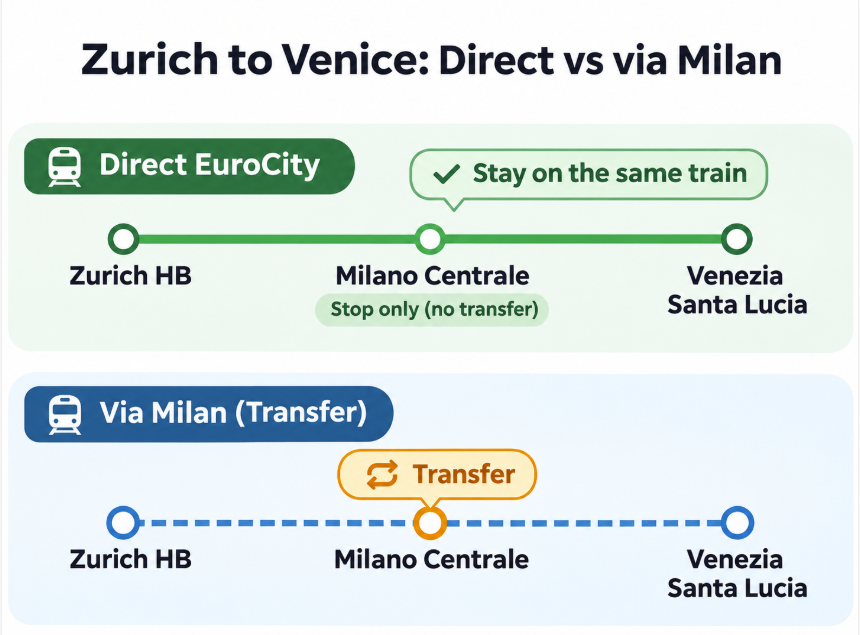
The Direct Zurich to Venice EuroCity
The direct EuroCity is one of the most convenient ways to travel between Switzerland and Venice.
You board at Zürich Hauptbahnhof (Zürich HB) and remain on the same train until Venice.
The journey follows the Gotthard corridor into Italian-speaking Switzerland, passing through places such as Bellinzona and Lugano before crossing into Italy.
From there, it continues through northern Italy toward Venice.
Does the Direct Train Stop in Milan?
Yes — and this is worth understanding before you travel.
The direct Zurich–Venice EuroCity stops at Milano Centrale, but that doesn't mean you have to change trains.
For example, Italian railway timetable information identifies EC 301 as a service running from Zürich HB through Milano Centrale to Venezia Santa Lucia.
If your booking shows the same through train all the way to Venice, you simply stay in your seat during the stop in Milan.
This is different from an itinerary that shows two separate trains, where you must leave the first service and board another.
When comparing tickets, look for "Direct" or "0 changes," not just the list of intermediate stops.
How Long Does the Direct Train Take?
SBB currently publishes a journey time of 6 hours and 9 minutes for its direct Zurich–Venice connection.
That makes it possible to leave Zurich in the morning and arrive in Venice during the afternoon, although actual departure times depend on the timetable in effect.
The journey isn't a dedicated panoramic train, but it does offer views of lakes, valleys, and northern Italian landscapes.
Part of the Alpine crossing passes through the Gotthard Base Tunnel, so don't expect uninterrupted mountain views throughout the trip.
If you're traveling mainly to reach Venice comfortably, the direct EuroCity is an excellent place to start.
When Does Changing Trains in Milan Make Sense?
The direct EuroCity is convenient, but its limited departures won't suit every itinerary.
You can also travel from Zurich to Milan on an international EuroCity and then board an Italian train toward Venice.
This gives you more flexibility when comparing departure times.
Zurich to Milano Centrale
The first leg normally takes around 3 hours and 17 minutes on the fastest direct EuroCity services.
Most Zurich–Milan international trains use Milano Centrale, but some services use Milano Lambrate or Milano Rogoredo instead.
This distinction matters when booking a connection.
If your onward train departs from Milano Centrale, make sure your incoming service actually arrives there. Don't assume that two tickets mentioning "Milan" use the same station.
You can find more details about the first part of the journey in our Zurich to Milan train guide.

Milano Centrale to Venice
From Milano Centrale, direct high-speed trains operated by Trenitalia and Italo connect Milan with Venice.
Many journeys take around two and a half hours, depending on the train and arrival station.
This is a different service from the international EuroCity you used to reach Milan.
If you're traveling to Venice's historic center, look for a train arriving at Venezia Santa Lucia, rather than automatically choosing the first result labeled Venice.
Our Milan to Venice train guide explains the difference between the two main Venice stations and the available high-speed options.
How Much Time Should You Allow to Change Trains?
Milano Centrale is a large station, but its mainline platforms are grouped together at the main concourse level.
If both trains use Milano Centrale, you generally won't need to leave the station building.
However, don't choose an extremely tight connection just because a journey planner displays it as possible.
You'll need time to leave the incoming train, locate your next platform, and board before departure.
If you're unfamiliar with the station or traveling with large suitcases, allowing a more comfortable transfer is sensible.
The correct connection time depends on your booking and the services involved. Check any minimum interchange time shown by the journey planner.
For help finding platforms and navigating the station, read our Milano Centrale practical guide.
What Happens If You Miss Your Connection?
This is one of the biggest differences between the direct journey and changing trains.
On the direct EuroCity, there's no connection to miss in Milan.
On a connecting itinerary, a delay to your first train could affect the second.
Before booking, check whether your journey is sold under one through-ticket or as separate transport contracts.
A through-ticket may provide stronger rights to onward travel if a delayed train causes you to miss your connection.
Separate tickets do not automatically provide the same protection. However, participating rail operators may offer assistance under the Agreement on Journey Continuation (AJC), subject to its conditions.
If a delay looks likely to cause a missed connection, speak to railway staff and request confirmation of the disruption. Don't simply assume you can board any later train.
For travelers who want to minimize this uncertainty, the direct EuroCity has a clear advantage.
How Much Does a Zurich to Venice Train Ticket Cost?
SBB currently advertises selected second-class direct EuroCity tickets from CHF 69, including a seat reservation.
This is a limited promotional starting fare, not a fixed ticket price.
Actual prices depend on your travel date, departure, travel class, availability, and fare conditions.
If you're traveling via Milan, the total price may include two separate rail segments:
- Zurich to Milan on an international EuroCity.
- Milan to Venice on an Italian high-speed train.
When comparing routes, look at the combined cost rather than the price of only the first train.
Also consider whether the cheaper option creates a much longer journey or a connection you would rather avoid.
Should You Book in Advance?
For an international journey like Zurich to Venice, booking ahead is generally sensible once your travel dates are confirmed.
The direct train has limited daily departures, and promotional tickets are subject to availability.
Waiting until the last minute could mean paying more or losing access to your preferred service.
But price isn't the only consideration.
Some discounted international fares have restrictions on changes and refunds. Standard fares may provide greater flexibility, subject to their own conditions and fees.
Make sure you understand what you are purchasing before choosing a discounted ticket.
Do You Need a Seat Reservation?
Yes. Seat reservations are compulsory for the international EuroCity services between Switzerland and Italy and are included in the relevant ticket price.
Check your booking for the train number, coach, seat, departure time, and arrival station.
If your itinerary includes a separate Italian high-speed train from Milan, that ticket will also have its own train and seat details.
Compare Routes with euTrain
Not sure whether to take the direct EuroCity or travel via Milan?
Use the euTrain app to search available Switzerland–Italy rail journeys, compare schedules and fares, and book supported routes from your phone.
Venezia Santa Lucia or Venezia Mestre?
This is the final detail that can make a significant difference to your arrival.
Venice has two major railway stations, but they serve different locations.
Venezia Santa Lucia is on the historic island of Venice, directly beside the Grand Canal.
When you leave the station, you're already in the part of Venice famous for its canals, bridges, and pedestrian streets.
You can walk toward your accommodation or use a vaporetto water bus, depending on where you're staying.
Venezia Mestre, on the other hand, is on the mainland.
It's a practical choice if your accommodation is in Mestre or you have an onward mainland connection.
However, if your hotel is in central Venice, arriving at Mestre usually means making an additional journey across the lagoon.
Many long-distance trains serve Mestre before continuing to Santa Lucia, but not every ticket covers travel to both stations.
Check the full arrival station name before paying.
For most first-time visitors staying in historic Venice, Venezia Santa Lucia is the more convenient choice.

Is the Bernina Express an Alternative?
You might also come across recommendations to travel from Switzerland to Italy via the Bernina Express.
It's one of Europe's best-known scenic railway experiences, but it's not a direct alternative to the regular Zurich–Venice EuroCity.
The Bernina route crosses the Alps toward Tirano in northern Italy. Continuing from there to Venice requires additional connections and substantially more travel time.
Choose this option if the Alpine scenery is an important part of your trip and you're prepared to spread the journey over more time.
If your priority is getting from Zurich to Venice efficiently, compare the direct EuroCity and the Milan connection instead.
Before You Travel: Four Things to Check
International railway journeys are usually straightforward, but a few details deserve attention.
1. Check the timetable for your actual date. The direct EuroCity has limited departures, and schedules can change during annual timetable updates or engineering work.
2. Confirm your train and seat. International EuroCity tickets are tied to specific services. If you're changing trains, keep the details for both legs accessible.
3. Carry valid travel documents. Switzerland and Italy are both in the Schengen Area, but identity and customs checks remain possible. Your passport or recognized ID must meet the requirements for your nationality.
4. Plan your arrival in Venice. If you're carrying luggage, check whether your hotel is within walking distance of Santa Lucia or whether a vaporetto will make the final journey easier.
Frequently Asked Questions
Is there a direct train from Zurich to Venice?
Yes. SBB currently advertises one daily direct EuroCity from Zürich HB to Venice. Check your date, as timetables and service availability can change.
How long is the train journey from Zurich to Venice?
The published direct journey takes as little as 6 hours and 9 minutes. Connections through Milan vary depending on the trains selected and the waiting time between services.
Do you need to change trains in Milan?
Not if you book the direct EuroCity. It may stop at Milano Centrale, but you remain on the same train. Other itineraries require a change in Milan.
What is the cheapest way to travel from Zurich to Venice by train?
There is no route that is always cheapest. SBB advertises limited direct EuroCity fares from CHF 69, while tickets via Milan have separate price structures. Compare total prices for your specific date.
Is there a high-speed train from Zurich to Venice?
The direct international service is an EuroCity train. If you change in Milan, the onward journey to Venice can be made on an Italian high-speed train operated by Trenitalia or Italo.
Which Venice station should I book?
Choose Venezia Santa Lucia if you're staying in Venice's historic center. Venezia Mestre is more convenient for accommodation on the mainland.
Is the train from Zurich to Venice scenic?
Parts of the journey offer attractive views of Swiss and northern Italian landscapes, but the direct EuroCity travels through the Gotthard Base Tunnel. It's primarily a practical international connection rather than a panoramic sightseeing service.
The Best Way to Travel from Zurich to Venice
If the daily direct EuroCity fits your schedule and budget, it's usually the simplest option. You can board in Zurich, stay on the same train through Milan, and arrive in Venice without managing a connection.
Traveling via Milan makes sense when you need a different departure time or find an itinerary with better overall value.
Whichever option you choose, check the full journey, ticket conditions, and Venice arrival station before booking.
The euTrain app can help you compare available European rail journeys and book supported services, so you can spend less time sorting through train options and more time planning your arrival in Venice.
Planning a multi-city trip around Europe? Use the eutrain app to search train routes and keep your journey options in one place.


