

Trenitalia vs Italo: Key Differences for Train Travel in Italy

Last reviewed: 17 November 2026
Trenitalia and Italo are Italy's two main competing high-speed train operators. Both run fast services between popular destinations including Rome, Florence, Milan, Venice and Naples. For most travellers, neither company is automatically better: the right choice is the train that serves your stations at a convenient time, with a fare and change policy that suit your plans.
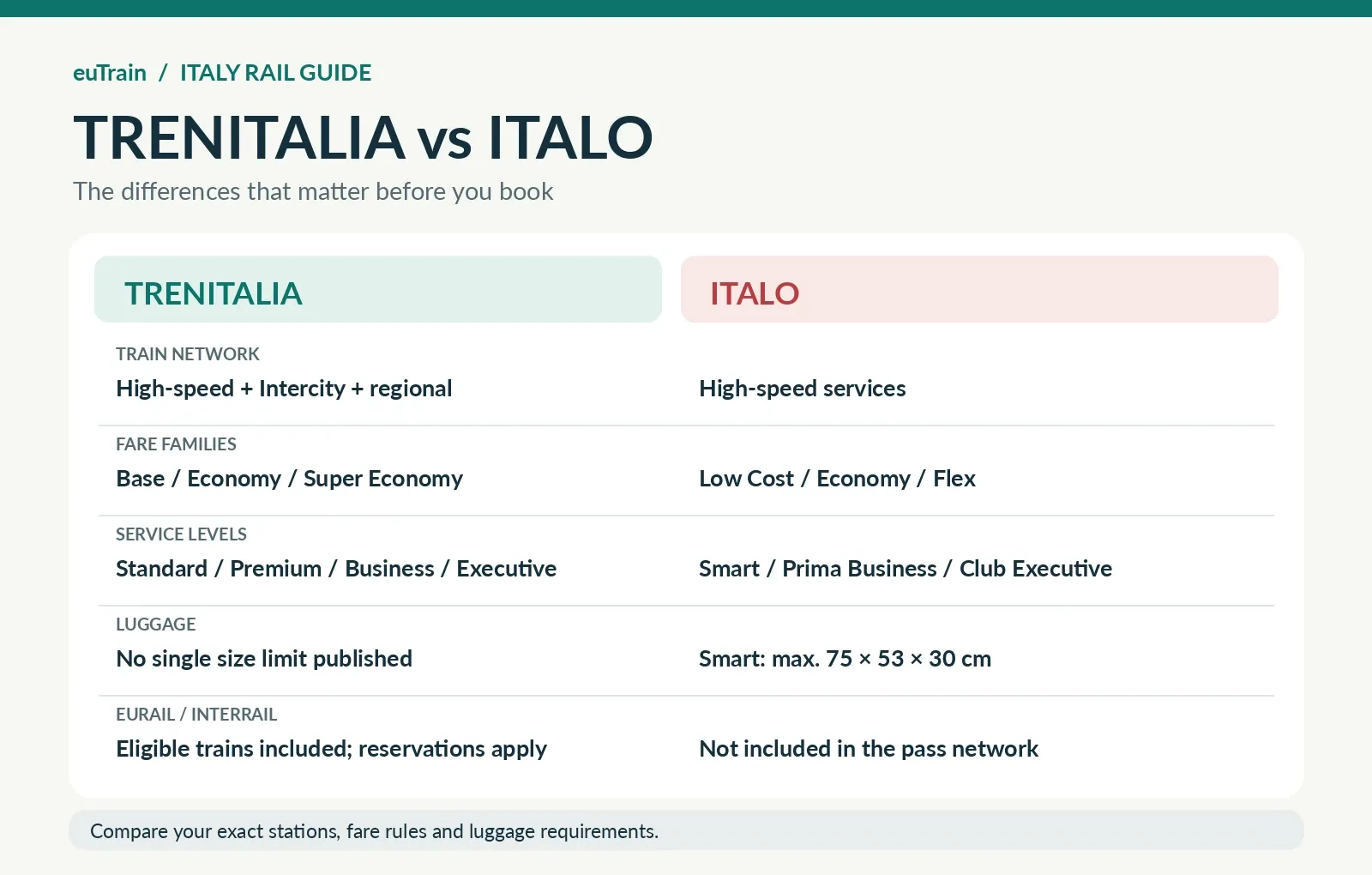
The biggest difference is network coverage. Trenitalia operates Frecciarossa high-speed trains alongside Intercity and regional services, while Italo concentrates on high-speed travel. If you're planning your first rail trip, start with our Italy Train Travel Guide.
1. Trenitalia vs Italo: Quick Comparison
| Feature | Trenitalia | Italo |
|---|---|---|
| Main services | Frecciarossa high-speed, Intercity and regional trains | High-speed trains |
| Where they compete | Many major intercity corridors | Many of the same major-city corridors |
| Standard fare families | Base, Economy, Super Economy on eligible long-distance trains | Low Cost, Economy, Flex |
| Comfort levels | Frecciarossa Standard, Premium, Business, Executive (depending on train) | Smart, Prima Business, Club Executive |
| Large luggage | No universal numerical suitcase limit stated in general guidance; safe storage required | Smart: maximum 75 × 53 × 30 cm; higher classes accommodate larger bags |
| Eurail / Interrail | Eligible Trenitalia trains are covered; high-speed reservations are usually required | Italo trains are not covered |
Fare availability, trains and onboard services vary. Always check the specific departure and ticket conditions.
Both operators use separate tickets and reservations. A Trenitalia ticket is not valid on an Italo train, and an Italo ticket is not valid on Trenitalia.
2. Routes and Stations: Which Operator Goes Where?
On high-speed routes such as Rome–Florence, Rome–Milan and Milan–Venice, you can often compare trains from both operators. A direct high-speed service can be an excellent choice with either company; check the actual journey time, intermediate stops and the station names before deciding.
Trenitalia has an advantage when your trip goes beyond the main high-speed corridors. Its regional and Intercity services can cover shorter journeys and additional towns that are not served by Italo's high-speed trains. That does not mean one Trenitalia ticket automatically covers every connection: separate legs may still need separate tickets and have different conditions.
Station names matter as much as the operator. In Rome, some high-speed departures use Roma Termini while others use Roma Tiburtina. In Milan, check whether your service uses Milano Centrale, Milano Rogoredo or another station. For Venice, Venezia Santa Lucia is on the historic island, whereas Venezia Mestre is on the mainland. Choosing a slightly cheaper service to the wrong station can add an inconvenient transfer.
Travellers also search for Trenitalia vs ItaliaRail, but ItaliaRail is a ticket booking platform rather than a train operator. We explain the difference in the FAQ below.
For route-specific advice, see our guides to Rome to Florence by train, Rome to Milan by train and Milan to Venice by train.
3. Ticket Prices: Compare the Fare, Not Just the Operator
There is no reliable universal answer to "Is Trenitalia or Italo cheaper?" Both use variable pricing. The final amount depends on your date, departure, available seats, service class and fare conditions. A cheaper advance ticket on one train may be less useful than a slightly more expensive ticket that lets you change your plans.
Trenitalia's main long-distance fare types include:
- Base: More flexible. Changes are generally permitted subject to the applicable conditions and any fare difference. For eligible services, a voluntary refund before departure normally involves a 20% deduction.
- Economy: A discounted fare with more limited flexibility. Date or time changes may be possible before departure by paying the difference to the applicable Base fare; ordinary cancellation refunds are not included.
- Super Economy: A more restrictive discounted fare. Ordinary changes and cancellation refunds are not included. An optional tiRimborso refund add-on may be available at purchase under its own conditions.
Italo's main fare types include:
- Low Cost: A restricted fare. A date/time change may be allowed up to 72 hours before departure with a fee of 60% of the ticket price plus any fare difference; do not assume a normal cancellation refund.
- Economy: Date/time changes are available under published conditions, generally with a 20% change fee plus any fare difference. The published voluntary cancellation refund is 40% of the fare.
- Flex: Designed for greater flexibility, with changes close to departure under the fare rules and a published 80% voluntary cancellation refund.
These are standard fare-rule summaries, not promises for every promotional ticket, special offer or add-on. Check the fare conditions on the final booking screen. Trenitalia and Italo also offer optional services that may change refund eligibility.
If you're travelling on a fixed date, compare the cheapest tickets that meet your needs. If you're connecting after a flight or have uncertain plans, compare the cost of flexibility, not just the headline fare. Our guide to cheap train tickets in Europe explains more ways to compare fares.
4. Seating Classes and Onboard Comfort
A fare type is not the same thing as a travel class. The fare determines conditions such as changes and refunds; the class determines your seat and onboard amenities. For example, a more flexible ticket does not necessarily mean a more spacious seat.
On Trenitalia Frecciarossa, the familiar service levels are Standard, Premium, Business and Executive, although individual trains can have three or four levels. Standard suits travellers who primarily want a comfortable high-speed journey. Premium offers an upgraded seating environment; Business provides more space and additional services; Executive is the top level on trains that offer it.
On Italo, the three main classes are Smart, Prima Business and Club Executive. Smart is the entry class with reclining seats, power outlets and Wi-Fi. Prima Business adds space and onboard hospitality. Club Executive is aimed at travellers prioritising privacy and premium services, including lounge access where available.
For a short trip such as Rome to Florence, an entry-level seat can be perfectly adequate. For a longer journey, or if you need to work, compare the price difference for a more spacious class. Always check which amenities are included on your exact train.
5. Luggage: What If You're Travelling with a Large Suitcase?
You carry your own luggage onto Italian trains, and ordinary passenger luggage is generally included without a separate fee. But the two operators publish different restrictions.
Trenitalia does not state one universal numerical suitcase dimension limit in its general luggage guidance. Bags must fit safely in available storage areas and must not block aisles, doors or staff access. That is not permission to bring any object regardless of size.
Italo Smart has a published maximum of 75 × 53 × 30 cm per item. Prima Business and Club Executive accommodate larger suitcases, but exceptionally bulky items can still be restricted. Measure the full external dimensions, including wheels and handles, rather than relying on a suitcase's advertised inch size.
If you're travelling with a large suitcase, check the class and storage rules before choosing a cheaper ticket. For the full operator-by-operator breakdown, see our Italy train luggage rules guide.
6. Eurail and Interrail: An Important Difference
If you hold a Eurail or Interrail Pass, this may decide the question immediately. Eligible Trenitalia services are part of the pass network, but Italo is not included. Pass holders generally need a separate seat reservation for Frecciarossa high-speed trains; having a pass does not mean you can board every high-speed departure without reserving.
Check the current pass timetable, reservation requirements and any exceptions before travelling. If you're using ordinary point-to-point tickets rather than a rail pass, compare the two operators normally.
7. Which Is Better for Your Trip?
Choose Trenitalia when:
- You need a regional or Intercity service rather than only a high-speed journey.
- You are travelling with an eligible Eurail/Interrail Pass and have arranged any required reservations.
- A Frecciarossa departure or fare works better for your stations and schedule.
Choose Italo when:
- You are travelling between cities served by Italo's high-speed network.
- An Italo departure has the better final price, station or timetable for your trip.
- You prefer a particular Italo travel class and the luggage and fare conditions suit you.
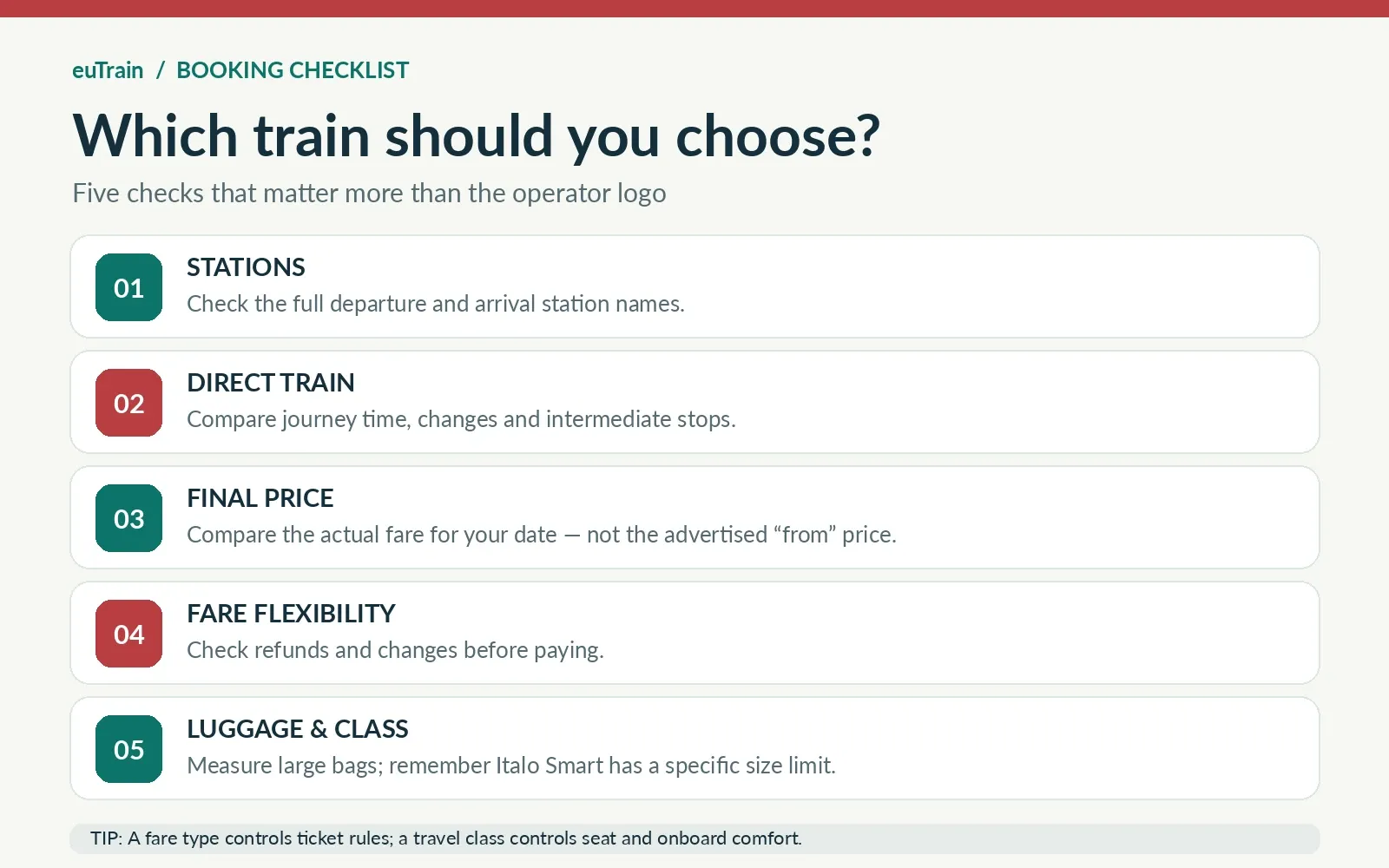
For either operator, use this order of checks: departure and arrival station → direct service and journey time → final price → change/refund rules → luggage and seat class. The most expensive train is not necessarily better, and the cheapest ticket is not necessarily the best value.
Frequently Asked Questions
Trenitalia vs ItaliaRail: What's the difference?
Trenitalia operates trains; ItaliaRail sells train tickets. ItaliaRail is a third-party booking platform and an official Trenitalia sales partner, not another high-speed train operator. Comparing Trenitalia with ItaliaRail is mainly about where to buy a ticket. Comparing Trenitalia with Italo is about which train operator to travel with. Before paying through any seller, compare the total price and support or refund arrangements.
Is Trenitalia faster than Italo?
Not necessarily. Both operate high-speed trains on many of Italy's main intercity corridors. Compare the actual scheduled journey times and stops for your date; the quickest operator can vary by departure.
Can I use a Trenitalia ticket on Italo?
No. The operators have separate reservations and ticket conditions. If your plans change, deal with your existing ticket according to its fare conditions before booking the other operator.
Which has better luggage rules, Trenitalia or Italo?
Trenitalia's general guidance does not publish a single universal size limit, whereas Italo Smart has a 75 × 53 × 30 cm limit. Italo's higher classes can accommodate larger bags. In every case, luggage must be stored safely and unusually bulky items may be restricted.
Can I use Eurail or Interrail on Italo?
No. Italo trains are excluded from the pass network. Eligible Trenitalia trains are included, but high-speed seat reservations may be mandatory and cost extra.
Final Verdict
For a straightforward Rome–Florence, Rome–Milan or Milan–Venice high-speed trip, compare Trenitalia and Italo side by side and choose the departure with the best mix of station, schedule, total price and ticket flexibility. Trenitalia is especially useful if your itinerary also includes regional or Intercity legs; Italo is a strong alternative on its high-speed network.
Planning several Italian train journeys? Explore related routes and practical travel advice with euTrain, and confirm the final timetable, fare conditions and booking details before you purchase.