

Cheap Train Tickets in Europe: How to Save on Rail Travel

Finding cheap train tickets in Europe is usually less about finding one secret booking site and more about knowing when to book, which trains to compare, and how flexible your travel plans are.
European rail fares can vary by route, operator, departure time and ticket type. On some high-speed trains, cheaper fares can disappear as the departure date gets closer. Regional trains often follow a different pricing structure and may offer less benefit from booking months in advance.
The best strategy is to focus first on the journeys where timing and demand matter most, then keep the more flexible parts of your trip open.

1. Book high-speed and long-distance trains earlier
For many long-distance and high-speed trains, booking earlier can give you access to a wider range of fares.
Lower-priced ticket categories may sell out before the train itself becomes full. That means seats can still be available later, but the cheapest fare you saw earlier may no longer be offered.
Early booking is especially worth considering when:
- your dates are fixed;
- you are travelling between major cities;
- you want a popular morning or evening departure;
- you are travelling during summer or holidays;
- you are travelling with several people.
This does not mean every train in Europe needs to be booked far in advance. Regional journeys are often more flexible.
For more detail, see How Far in Advance to Book Train Tickets in Europe.
2. Compare more than one departure time
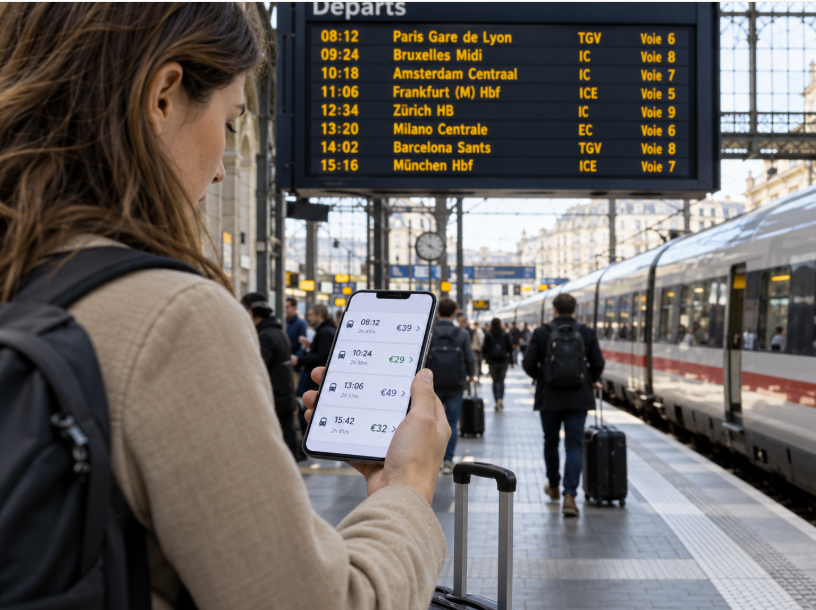
One of the easiest ways to find a better fare is to compare several trains on the same route.
Instead of searching only for one preferred departure, look at:
- early-morning trains;
- midday services;
- evening departures;
- direct trains;
- journeys with one connection.
Demand can vary throughout the day, so another train on the same route may offer a lower fare.
The cheapest option is not always the best one, though. A slightly more expensive direct train may be better value than a cheaper journey with a long connection.
3. Compare fare conditions, not just the price
A low ticket price can look attractive until you need to change your plans.
Before choosing the cheapest fare, check:
- whether the ticket is refundable;
- whether changes are allowed;
- whether a change fee applies;
- whether the ticket is valid only on one train;
- whether a seat reservation is included.
If your itinerary is fixed, a restricted fare may be completely suitable.
If your travel plans could change, paying a little more for flexibility can sometimes save you money later.
If you are still learning how European rail booking works, our How to Book Train Tickets in Europe guide explains the full booking process.
4. Be flexible with your travel date when possible
Travel demand changes by day as well as by time.
If your itinerary allows it, compare nearby dates before booking.
Busy periods can include:
- Friday evenings;
- Sunday afternoons;
- public holidays;
- summer weekends;
- school holidays;
- major events.
Moving your journey by a day, or even by a few hours, can sometimes give you more options.
This is especially useful when travelling between popular European cities.
5. Understand the difference between high-speed and regional trains
Not every European train follows the same pricing model.
High-speed and long-distance trains
These are usually the journeys where booking timing matters most. Fares can vary depending on demand and ticket conditions.
Regional trains
Regional services often use simpler pricing structures and may offer less benefit from booking far in advance.
This means you do not need to plan every part of a budget train trip in the same way.
A practical approach is to book the expensive or high-demand journeys first, then leave more flexible regional trips until later when appropriate.
If you are travelling in Italy, our Italy Train Travel Guide explains the main train types and how they fit into a typical trip.
6. Compare operators when a route has more than one option
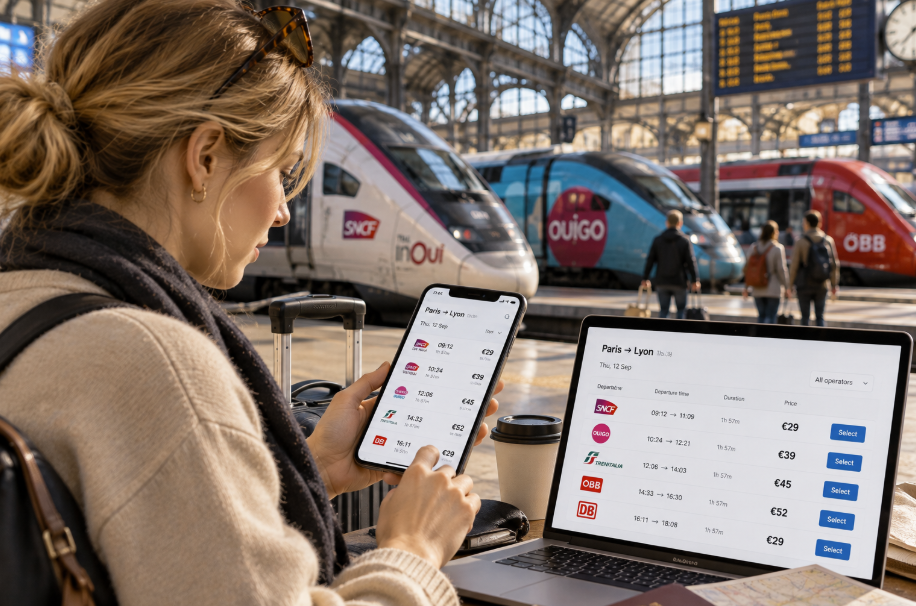
Some routes are served by more than one train company.
When that happens, compare more than the departure time.
Different operators may offer different:
- fares;
- ticket conditions;
- travel classes;
- onboard services;
- luggage rules.
Italy is a good example. Some major high-speed routes are served by both Trenitalia and Italo.
If you are planning an Italian high-speed journey, see our Trenitalia vs Italo Guide.
7. Check whether a rail pass really saves money
A rail pass can be useful for some itineraries, but it is not automatically the cheapest option.
Before choosing a pass, compare:
- how many travel days you need;
- which countries you will visit;
- the price of individual tickets;
- whether seat reservations cost extra;
- how flexible your route needs to be.
Travellers taking only a few major journeys may find individual tickets more economical.
Travellers making many journeys across several countries may value the flexibility of a pass more highly.
The important point is to compare the pass with your actual itinerary rather than assuming one option is always cheaper.
8. Look at the total journey cost
The train ticket itself is only one part of the cost.
A very cheap fare may be less attractive if the train:
- departs from a distant station;
- arrives very late at night;
- requires an expensive local transfer;
- involves changing stations;
- creates a very long connection.
Always check where the train leaves from and where it arrives.
For example:
- Milano Centrale Train Station Guide
- Roma Termini Train Station Guide
- Firenze Santa Maria Novella Train Station Guide
A slightly more expensive train from a convenient station may still cost less overall.
9. Avoid paying for flexibility you do not need
Flexible tickets can be useful, but they are not always necessary.
If your hotels, flights and travel dates are already confirmed, you may not need to pay extra for a fully flexible fare.
On the other hand, if your itinerary is still changing, a very restrictive ticket can become expensive if you later need to rebook.
Think about how certain your plans are before choosing the fare.
10. Check ticket rules before you travel
A cheap ticket is only good value if you understand how to use it.
Before travelling, check:
- whether the ticket is tied to one departure;
- whether you need a seat reservation;
- whether the ticket is digital;
- whether any validation is required;
- what happens if you miss the train.
If you are travelling on regional trains in Italy, read How to Validate Train Tickets in Italy.
11. Compare the full journey, not only the headline fare
When looking for budget train tickets in Europe, compare the complete trip.
| What to compare | Why it matters |
|---|---|
| Ticket price | Shows the basic fare |
| Journey time | A cheaper trip may take much longer |
| Number of changes | More transfers can make the journey harder |
| Station location | A distant station can add extra cost |
| Fare flexibility | Changes or refunds may cost more later |
| Seat reservation | Some journeys may require an additional reservation |
The lowest number on screen is not always the best-value option.
Is it cheaper to buy train tickets online?
Online and mobile booking make it easier to compare routes, fares and departure times before travelling.
The main advantage is that you can see several options at once rather than arriving at the station with only one departure in mind.
For multi-country trips, using a train app can also help keep route searches and ticket information in one place.
If you are comparing booking tools, see our Best App for Train Tickets in Europe guide.
CTA: Search European train routes and tickets with the eutrain app.
Are last-minute train tickets expensive in Europe?
It depends on the train.
High-speed and long-distance services may have fewer low-priced fares available close to departure.
Regional trains often show much less price variation.
If you are booking at the last minute, compare several departures instead of assuming every train on the route will cost the same.
FAQ
What is the cheapest way to travel by train in Europe?
There is no single cheapest method. Compare individual tickets, operators, departure times and rail passes based on your itinerary.
Are European train tickets cheaper if booked early?
Many high-speed and long-distance trains can offer lower fares earlier, while regional ticket prices often change less.
What is the best day to buy train tickets in Europe?
There is no universal cheapest booking day. Route, travel date, demand and fare availability matter more than the weekday on which you buy.
Are weekday train tickets cheaper in Europe?
Sometimes. Demand can be lower on certain weekday departures, but pricing varies by route and operator.
Should I always choose the cheapest fare?
Only if the ticket conditions suit your plans. Check change, refund and train restrictions before booking.
Are rail passes cheaper than individual train tickets?
Sometimes, but not always. Compare the cost of your actual journeys and any required reservations before deciding.
Find the right fare for your European train journey
Finding cheap train tickets in Europe comes down to a few practical choices: book high-demand journeys earlier, compare several departures, understand the fare conditions and stay flexible where possible.
For a multi-city trip, start with the routes that are most expensive or hardest to replace, then plan the more flexible journeys around them.
Search European train routes and tickets with the eutrain app.
Download the eutrain app