

Venice Santa Lucia Train Station: From Platform to Canal

Arriving at Venice Santa Lucia train station is unlike arriving at most European railway stations. Step outside and you're immediately facing the Grand Canal — no metro ride or taxi transfer needed to reach Venice's historic center.
But that doesn't mean your journey is finished.
You might need a vaporetto (water bus) to reach your hotel, a walk across several bridges, or another train if you've accidentally booked Venezia Mestre instead of Santa Lucia.
Here's what to expect at Venezia Santa Lucia, how to find your next connection, and what to check before booking a train to or from Venice.
Venice Santa Lucia Train Station: The Essentials
Venezia Santa Lucia is Venice's main railway station on the historic island. It sits in the Cannaregio area, directly beside the Grand Canal.
The official railway name is Venezia S. Lucia, although journey planners often display it as Venezia Santa Lucia or Venice Santa Lucia.
| Station detail | What you need to know |
|---|---|
| Official name | Venezia Santa Lucia (Venezia S. Lucia) |
| Location | Historic Venice, beside the Grand Canal |
| Main operators | Trenitalia, Italo and regional services |
| Station type | Mainline terminal station |
| Water bus connection | Ferrovia vaporetto stops outside |
| Road transport | Available from nearby Piazzale Roma |
| Other major Venice station | Venezia Mestre, on the mainland |
| Best for | Visiting or staying in historic Venice |
Santa Lucia is a terminal station: trains arrive and depart from platforms that end at the station rather than passing through it.
For most travelers arriving from cities such as Milan or Florence, this is the railway station that brings you directly into historic Venice.
Venice Santa Lucia vs Venezia Mestre: Which Station Do You Need?
This is the most important distinction to understand when booking a train to Venice.
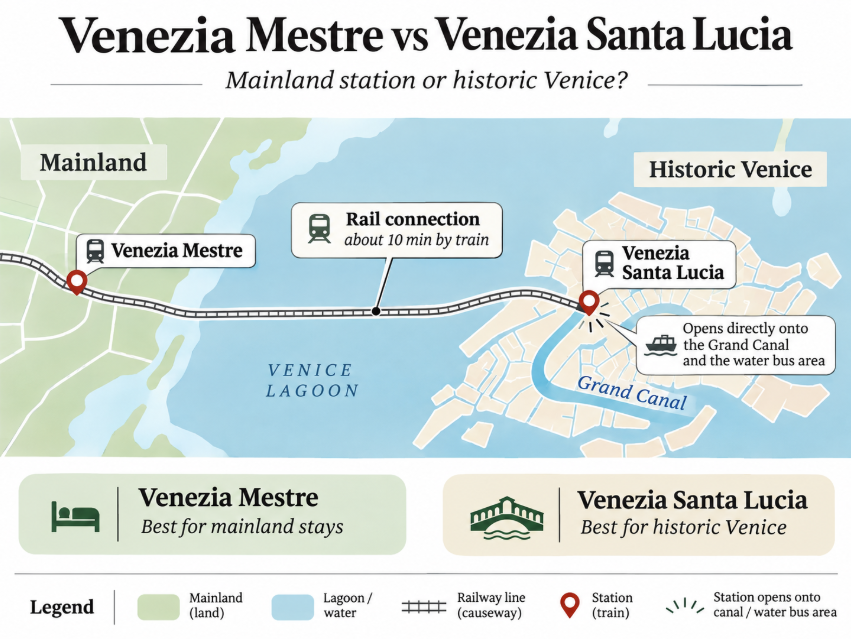
Although both stations appear under "Venice" in journey planners, they serve different locations.
Venezia Santa Lucia: For the Historic City
Choose Santa Lucia if you're staying in Venice's historic center, including areas such as Cannaregio, San Polo, Santa Croce, Dorsoduro or San Marco.
You'll arrive on the island, where most streets are pedestrian-only and canals replace ordinary city roads.
From the station, you can walk or take a water bus to your accommodation.
Venezia Mestre: For the Mainland
Venezia Mestre is on the mainland, before the railway line crosses the lagoon to Santa Lucia.
It's often the more useful choice if your hotel is in Mestre, you're making a mainland connection or your itinerary doesn't require entering historic Venice.
Trains between Mestre and Santa Lucia usually take around 10 minutes, although the exact service depends on the timetable.
| Venezia Santa Lucia | Venezia Mestre | |
|---|---|---|
| Location | Historic Venice island | Mainland |
| Best for | Historic center and canals | Mestre accommodation and mainland connections |
| Grand Canal access | Immediately outside | Requires onward travel |
| Water buses | Ferrovia stops nearby | Not directly at the station |
| Train connection between stations | Approximately 10 minutes | Approximately 10 minutes |
If your hotel is in historic Venice, Santa Lucia is usually the more convenient arrival station.
What If You Booked Mestre by Mistake?
First, check whether your train continues beyond Mestre to Santa Lucia.
Many long-distance trains serve both stations, but not every service does.
Even if your train continues to Santa Lucia, a ticket ending at Mestre doesn't automatically cover the additional journey.
Check your fare and ticket conditions before traveling beyond the station printed on your booking. You may need an additional ticket.
For a route-specific example, see our Milan to Venice train guide, which explains why the arrival station matters when comparing trains.
What Happens When You Leave Santa Lucia Station?
After getting off your train, follow the signs toward the main station exit.
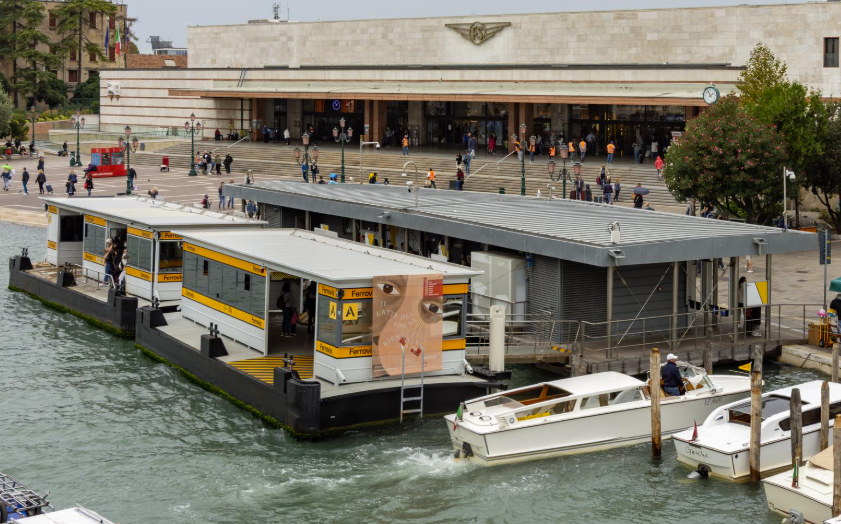
The main entrance opens onto a broad waterfront area overlooking the Grand Canal.
You'll see boats, pedestrian paths and historic buildings rather than the usual taxi ranks and buses found outside major railway stations.
This is where the final part of your journey begins.
There are three main options: walk, take a public water bus or arrange a water taxi.
Option 1: Walk to Your Hotel
Walking can be the simplest choice if your accommodation is nearby.
Areas such as western Cannaregio and parts of Santa Croce are accessible on foot from the station.
However, distance on a Venice map doesn't tell the whole story.
A route that looks short may cross several bridges, involve steps or pass through narrow pedestrian streets.
If you're traveling with large suitcases, check the actual walking route before deciding to skip the water bus.
Also look at the entrance to your hotel. Some properties are inside historic buildings where stairs are unavoidable.
Option 2: Take a Vaporetto from Ferrovia
A vaporetto is Venice's public water bus.
The nearest main boarding area to Santa Lucia is called Ferrovia, located along the Grand Canal in front of the station.
You'll find multiple boarding pontoons rather than one single platform for every destination.
Different lines and directions use different stops, so don't board the first boat simply because it is waiting outside.
ACTV Line 1 is a useful service for destinations along the Grand Canal, including Rialto and the San Marco area. Line 2 provides other connections, depending on its operating pattern.
Some journeys to other parts of Venice or the lagoon may require a different line or a transfer.
Before boarding:
- Identify the nearest vaporetto stop to your accommodation.
- Check the correct line and direction.
- Find the relevant Ferrovia boarding pontoon.
- Make sure you have the appropriate local transport ticket.
The vaporetto ticket is generally separate from your railway ticket.
If you plan to make multiple water-bus journeys, compare the available single-journey and time-based transport tickets.
Option 3: Take a Water Taxi
Water taxis offer a more private transfer, but they are generally substantially more expensive than public water buses.
They can be useful when traveling in a group, carrying several suitcases or staying somewhere with suitable water access.
However, not every hotel has a private landing point. You may still need to walk a short distance from the nearest accessible dock.
Confirm the destination and fare arrangements before traveling.
How to Get from Santa Lucia to Piazzale Roma
If you're looking for a bus or road taxi, you'll need to reach Piazzale Roma, Venice's main road-transport terminal.
Santa Lucia itself doesn't have a conventional road taxi rank outside the station entrance.
Piazzale Roma is roughly a 10-minute walk from Santa Lucia via the Ponte della Costituzione bridge.
The bridge has steps, so travelers with heavy luggage or mobility needs should check the accessible transfer options rather than assuming the walking route will be easy.
From Piazzale Roma, you can find road connections to mainland destinations and Venice Marco Polo Airport.
This distinction is particularly useful when planning a train-to-airport transfer.
Is There a Train from Santa Lucia to Venice Marco Polo Airport?
No. Venice Marco Polo Airport doesn't have a direct railway station.
If you're leaving Venice by air, you need to combine your railway journey with another form of transport.
One common option is to walk from Santa Lucia to Piazzale Roma and take an airport bus.
Other water-transport and taxi options may be available depending on your starting point.
Don't book an airport connection based only on the train's arrival time. Allow time for walking, luggage, transport waiting and airport procedures.
Our Venice Airport to Venice Train Station guide explains the airport and railway connections in more detail.
Taking a Train from Venezia Santa Lucia
Santa Lucia is also a major departure point for travelers continuing across Italy and into neighboring countries.
Both high-speed and regional services operate from the station.
Finding Your Platform
Before boarding, check the departure screens in the main station area.
Italian railway signs use the word binario for platform.
Look for your train number, scheduled departure time, destination and platform assignment.
Don't rely only on the final destination displayed. Your train may continue beyond the city where you plan to get off.
Platform information can change, so check the boards again before heading to the train.
Santa Lucia is a terminal station, which generally makes boarding less complicated than changing between distant platforms at a large through-station.
Even so, allow enough time to find your service, especially during busy travel periods.
High-Speed vs Regional Tickets
High-speed tickets with Trenitalia or Italo normally include a reserved seat and are valid for the specific booked service.
Regional tickets work differently. Ordinary regional services generally don't have assigned-seat reservations, and the ticket's validation and change rules depend on its format.
For example, Trenitalia's Digital Regional Ticket is automatically validated at the scheduled departure time of the selected train.
Always check your exact ticket conditions rather than assuming every Italian train ticket follows the same rules.
Popular Train Routes from Venice Santa Lucia
Santa Lucia connects Venice with several of Italy's major cities, making it a convenient starting point for a wider rail trip.
Venice to Milan
Direct high-speed services connect Venice with Milan, passing through northern Italian cities along the way. Check whether your chosen Milan departure or arrival station is Centrale or another station.
Venice to Florence
High-speed trains provide a convenient way to travel between Venice and Florence. Compare Trenitalia and Italo departures, ticket conditions and the exact Florence station.
Venice to Zurich
Cross-border journeys connect Venice with Switzerland. Depending on the timetable and chosen departure, you may find a direct EuroCity or an itinerary requiring a connection.
Our Zurich to Venice train guide explains the direct service and Milan transfer options.
Compare Trains with euTrain
Planning to travel beyond Venice?
Use the euTrain app to compare available European train journeys, check supported ticket options and book eligible rail services.
Download euTrain for iPhone | Get euTrain on Android
Before purchasing, check whether your ticket starts or ends at Venezia Santa Lucia or Venezia Mestre.
Facilities at Venice Santa Lucia Station
Santa Lucia provides the main facilities you'd expect at a large railway terminal, including ticket services, shops and luggage storage.
Services and operating hours can change, so check the latest availability before relying on a particular facility.
Luggage Storage
Luggage storage is available at the station, making it possible to explore Venice without carrying every bag through the historic streets.
Check the current opening hours, prices and collection procedures before leaving your bags.
If you're returning for an evening train, allow time to retrieve your luggage and reach your platform.
Accessibility
RFI provides assistance services for eligible passengers with reduced mobility through its Sala Blu network.
Arrange any required assistance in advance according to the operator's instructions.
Remember that accessibility doesn't stop at the railway station entrance. Your onward route may include bridges, steps and water-bus pontoons, so the complete journey deserves planning.
Frequently Asked Questions
Is Venice Santa Lucia the main train station?
Yes. Venezia Santa Lucia is the main railway station serving Venice's historic island. Venezia Mestre is another major station, located on the mainland.
Is Santa Lucia station on the Grand Canal?
Yes. The main station entrance faces the Grand Canal, with public water-bus stops nearby.
How do I get from Santa Lucia station to San Marco?
You can walk through Venice or take a suitable vaporetto from the Ferrovia boarding area. The best choice depends on your luggage, mobility and available time.
How far is Venezia Mestre from Santa Lucia?
The train journey between the two stations usually takes around 10 minutes. Check the available services and make sure your ticket covers the journey.
Can I get a taxi outside Santa Lucia station?
Water taxis are available nearby. For conventional road taxis and buses, you generally need to reach Piazzale Roma.
Do I need a separate ticket for the vaporetto?
Generally yes. Public water-bus travel uses its own ticket system and isn't automatically covered by an ordinary train ticket.
Does Venice Santa Lucia have luggage storage?
Yes, luggage storage facilities are available. Check current opening hours, prices and conditions before traveling.
Can I buy train tickets from Santa Lucia to other Italian cities?
Yes. The station serves high-speed and regional rail routes. You can compare available train services and purchase supported tickets using the euTrain app.
Before You Leave or Arrive at Santa Lucia
The most important thing to understand about Venice Santa Lucia is its location.
Santa Lucia brings you directly into Venice's historic center; Mestre does not.
If you're arriving, work out whether you need to walk, take a vaporetto or transfer to Piazzale Roma. If you're departing, confirm the station name, train number and ticket conditions before heading to the platform.
A little planning makes the transition between Venice's railway network and its canals much easier.
For more information on stations, operators and booking trains around Italy, explore our Italy Train Travel Guide or compare supported journeys in the euTrain app.
Planning a multi-city trip around Italy? Use the eutrain app to search train routes and keep your journey options in one place.


